
History and Evolution of the SWGM
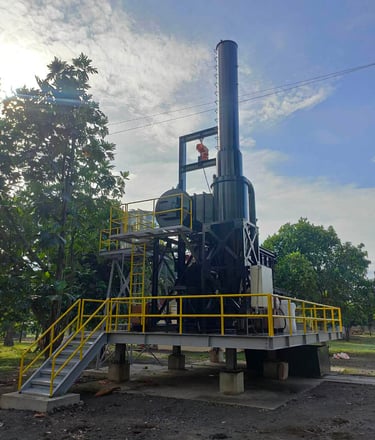
The SWGM technology was developed by Tadahiro Murakami, a Japanese engineer in Miyagi Prefecture, Japan, in the late 1990s. Since then, the SWGM is used in various parts of Japan in managing their municipal solid waste.
In 2018, Engr. Murakami and a Nepali businessman, Mr. Pravakar Bikram Shah, made an agreement to modify the SWGM to address the problems of Asian countries on their municipal solid waste.
In 2022, Mr. Shah together with Mr. Eduardo Antonio Veloso, a Filipino businessman, established The One Ecology World Corporation. Its purpose is to manufacture in the Philippines and market the SWGM locally and abroad.
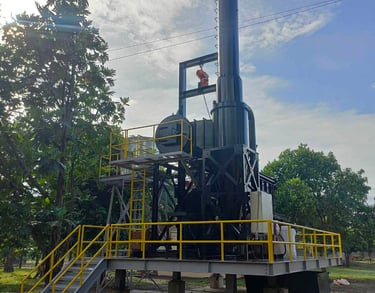
In 2023, the first SWGM was manufactured and tested. It underwent rigorous testing, both operational and environmental. Armed with highly skilled engineers and expert steel fabricators, the SWGM is now ready to provide solutions to the growing solid waste problem of the world.
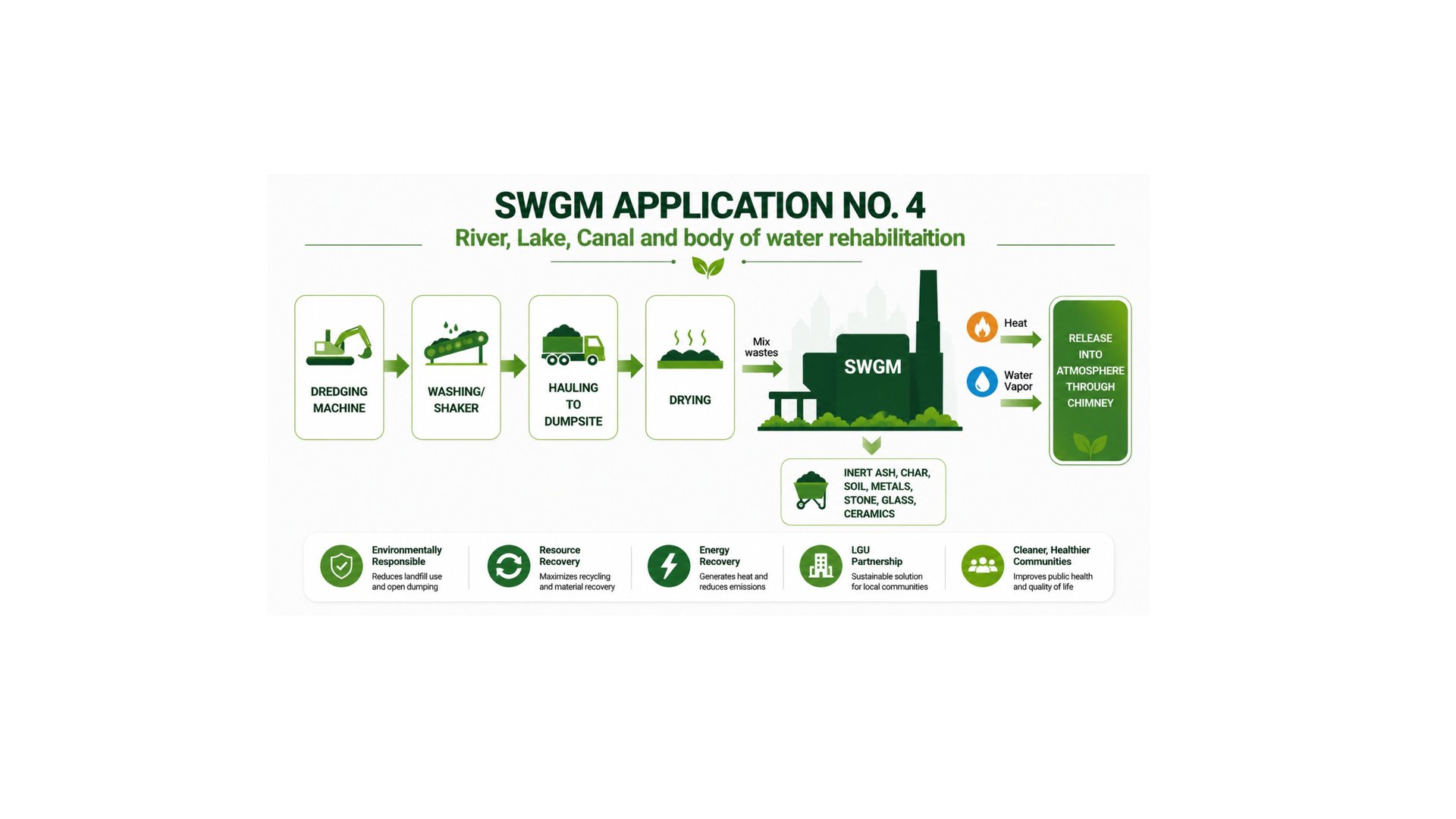
SWGM System — How It Works
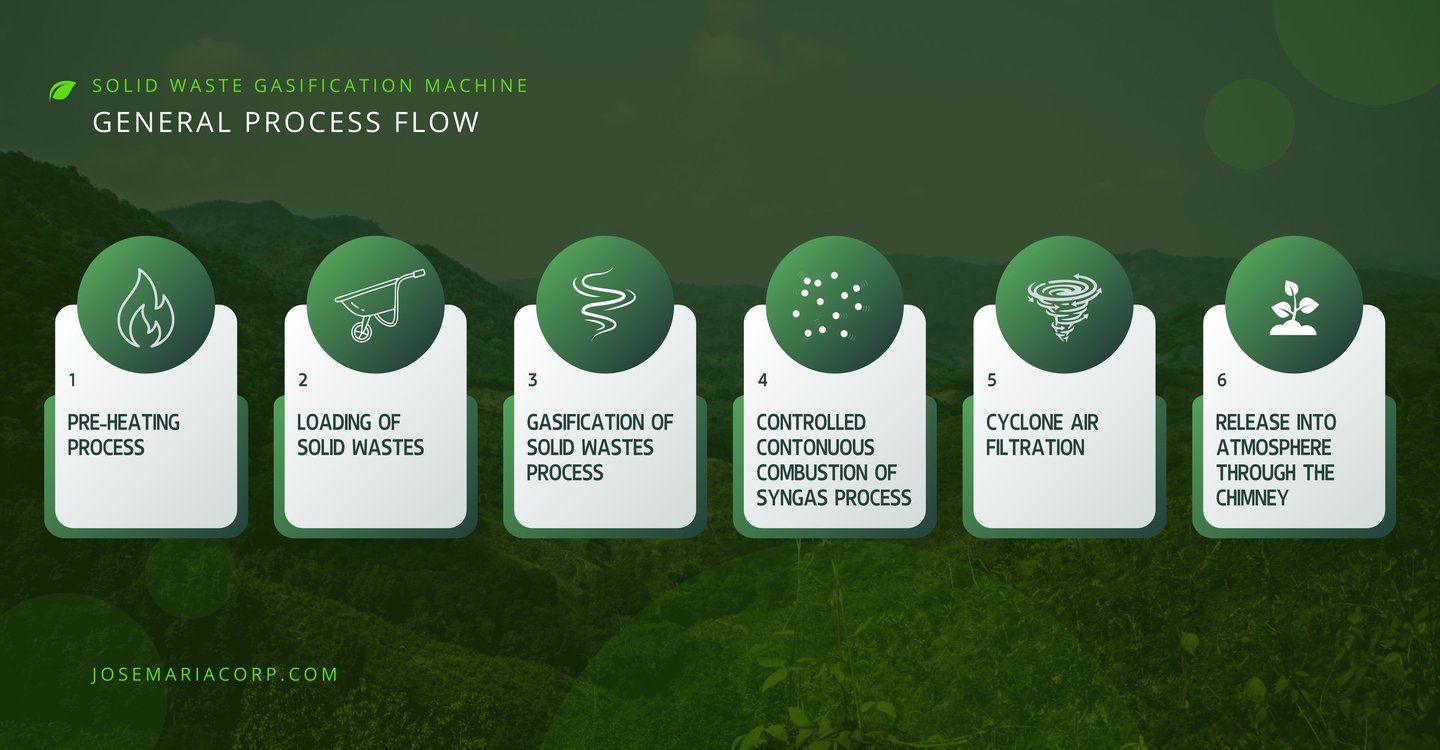
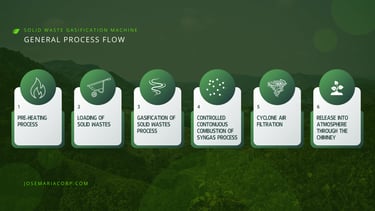
The SWGM (Solid Waste Gasification and Management) platform represents a next-generation approach to municipal solid waste treatment — engineered to transform everyday refuse into recoverable energy with a minimal atmospheric footprint. Each stage of the system is sequenced to maximize thermal efficiency, emission control, and operational continuity.
Stage 1 — PRE-HEATING PROCESS Before waste enters the primary chamber, the system brings the reactor environment up to the required operating temperature. This warm-up phase stabilizes combustion conditions and ensures that subsequent stages perform within precise thermal parameters from the outset.
Stage 2 — LOADING OF SOLID WASTES Prepared municipal solid waste is introduced into the gasification chamber through a controlled loading sequence. This stage governs feed rate and material distribution to maintain consistent throughput and prevent thermal disruption during processing.
Stage 3 — GASIFICATION OF SOLID WASTES PROCESS Inside the reactor, solid waste undergoes thermochemical breakdown in a low-oxygen environment — a process that converts organic material into synthetic gas (syngas). Residual inert materials are separated: Inert ash and char byproducts are safely collected and managed.
Stage 4 — CONTROLLED CONTINUOUS COMBUSTION OF SYNGAS PROCESS The syngas produced in Stage 3 is channeled into a secondary combustion zone, where it is burned under carefully managed conditions. This step ensures maximum energy recovery and stable system performance, while producing fly ash and water vapor as secondary outputs.
Stage 5 — CYCLONE AIR FILTRATION Before the exhaust gases are released, they pass through a Cyclone Air Filtration unit. This step removes inert fly ash and other particulate matter, ensuring cleaner emissions.
Stage 6 — RELEASE INTO ATMOSPHERE THROUGH CHIMNEY The cleaned gas Finally, the treated gases—now reduced to heat and water vapor—are safely released into the atmosphere through a chimney, in full compliance with environmental standards.
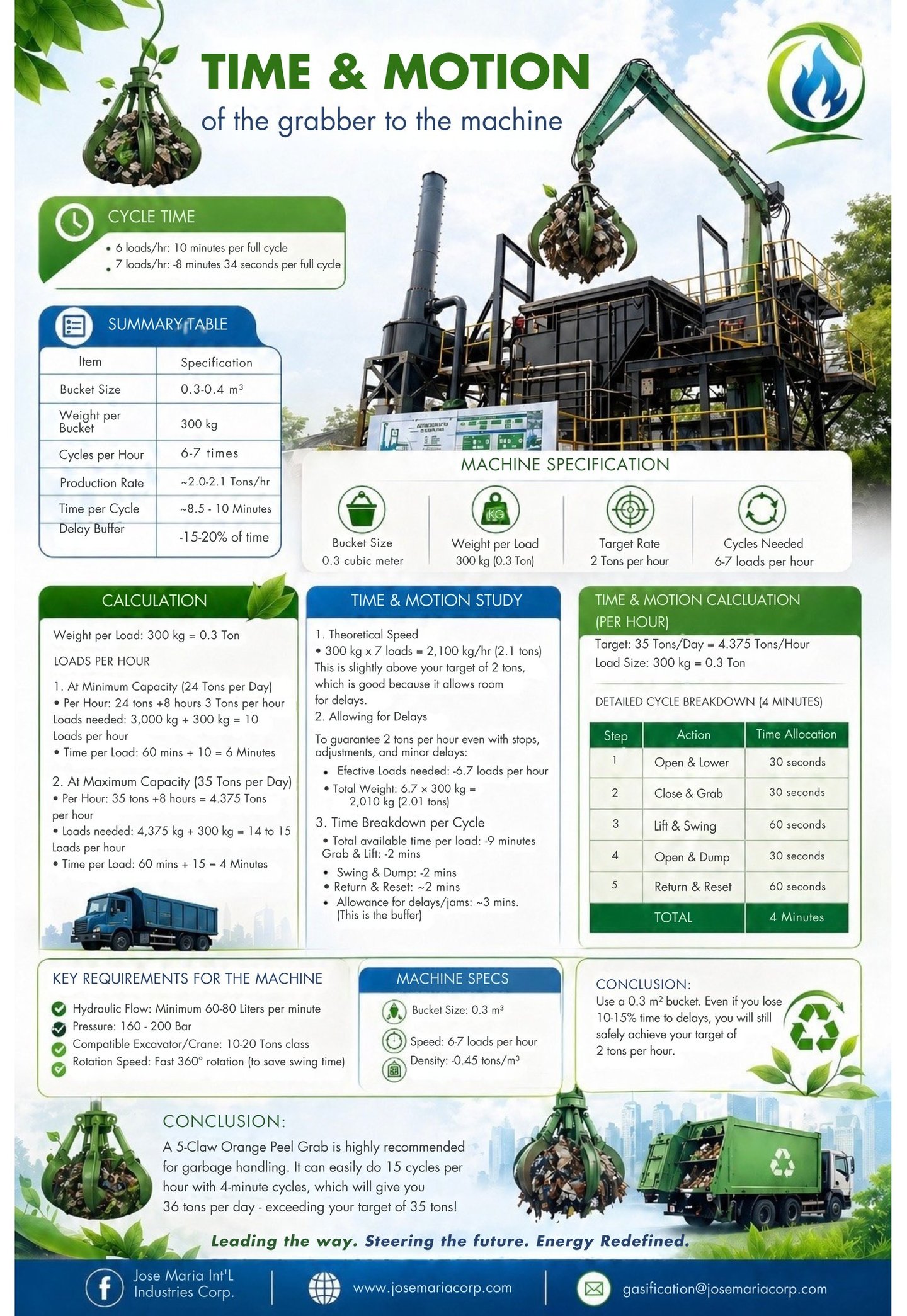
TIME AND MOTION:
FROM GRABBER TO MACHINE
contact@josemariacorp.com
josemariacorp
josemariacorp.com
(63) 9178547809
© 2025. Jose Maria Int'l Industries Corp.
An independent marketing entity facilitating introductions to industrial waste gasification solutions for medium to large-scale waste disposal in the Philippines.




54F Finance Corporate Plaza, Ruby Road, Ortigas Center, Pasig City, Philippines 1605


GASIFICATION | SWGM | SERVICES | ABOUT US | CONTACT US